
Our Recommendation
Fika (formerly Bridges to Prosperity) has partnered with academic economists at Yale, Notre Dame, and the University of Colorado to conduct a Randomized Controlled Trial (RCT) across 147 sites in Rwanda, including 50 long-term control sites, specifically designed to produce causal estimates of impact across economic, agricultural, health, and educational outcomes. Preliminary findings from this RCT and from the published Nicaragua quasi-experiment by Brooks and Donovan (2020) demonstrate strong, causally-attributed evidence that trail bridges produce significant increases in household income, farm profits, and labor market participation. The organization's Theory of Change is clear, testable, and grounded in the specific negative consequences of rural isolation. Fika has shown genuine learning and adaptation over time, pivoting from a build-focused model to a systems-change model working directly with national governments to scale rural access programs country-wide.
Fika's Fierce Certification score is 90/100 based on our criteria:
✔ Has Ultimate Outcome Goals (50 pts)
✔ Measures Intermediate Outcomes (10 pts)
✔ Measures Ultimate Outcomes (0 pts)
✔ Shows Continual Learning & Adaptation (25 pts)
✔ Measures Intermediate Counterfactual (0 pts)
✔ Measures Ultimate Counterfactual (5 pts)
The Social Problem
More than one billion people globally lack access to an all-season road within two kilometers of their home. For rural communities in low-income countries this isolation is not merely an inconvenience. When the only route to a town market, a health clinic, a school, or an employer runs through an impassable river, the consequences compound across every dimension of life. Income opportunities disappear during flood seasons. Sick children cannot reach a hospital. Pregnant women die in preventable childbirth emergencies. Teachers and health workers cannot reliably serve the communities that need them. Agricultural goods rot because they cannot be transported to market. In Rwanda alone, 57% of rural households must cross a river to reach a hospital, and more than 30% must cross a river to reach a school. The World Bank estimates that nearly a billion people worldwide face this form of isolation, and that rural isolation is one of the most persistent root causes of poverty.
The Solution
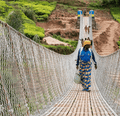
Fika (formerly Bridges to Prosperity) designs, builds, and advocates for trail bridges. These are cable-suspension pedestrian bridges that safely span impassable rivers and connect rural communities to the road networks, markets, health facilities, schools, and employers on the other side. These are not simply construction projects. Fika's model involves a full cycle of community-driven site assessment, bridge design, local construction management with government cost-sharing, and long-term community maintenance training.
In its current form, the model operates at national scale in partnership with government ministries in Rwanda, Uganda, and Ethiopia. Under a Memorandum of Understanding (MoU) with Rwanda's national government, for example, Fika works with district governments on a reimbursement model with 30–40% government cost-sharing per bridge. In Uganda, Fika serves as a technical assistance and advocacy partner to the Ministry of Works and Transport, organizing stakeholder coalitions and designing data-driven rural access plans. In Ethiopia, Fika partners with Helvetas and the national government to replicate a successful regional program at national scale. The organization also develops digital tools such as satellite mapping, sensor-based bridge use monitoring, and needs assessment applications to identify where bridges are most needed and to measure impact at scale.
Key Outputs
As of their most recent reporting, Fika has accomplished the following:
- The completion of more than 800 trail bridges across 21 countries, serving over 5.1 million community members with safe access.
- The assessment of more than 5,500 access barriers across 29 countries and identified more than 9 million people currently without safe access.
- In Rwanda specifically, the five-year program (2019–2024) targeted the construction of approximately 200 bridges serving 660,000 people, with 100% of the rehabilitation backlog cleared in four districts and 10% of required new culverts, bridges, and hillside infrastructure constructed across four districts. -
- In Ethiopia, the TRAIL-Ethiopia program targets 150 bridges serving approximately 1.3 million people between 2022 and 2025.
Key Intermediate Outcomes
Fika's strongest and most rigorously documented intermediate outcomes come from two studies. The first is the Brooks and Donovan (2020) quasi-experimental study of Fika bridges in Nicaragua, published in Econometrica. This study compared villages that received bridges to matched villages that did not, using a difference-in-differences design. It found that the average household in a bridge village experienced a wage earnings rise of approximately 19–20% (depending on whether the week was flooded), a farm profits rise by 75%, and agricultural goods transported across the river increase by 1,350% (14x by volume).
Total annual household income increased by approximately 25–29% across the two studies. Women entering the labor market increased by 60% in bridge communities. The second study is the ongoing Rwanda RCT, for which preliminary results have been published. In the Rwanda context, total harvest value increased 10% over baseline and cash crop harvest specifically increased 18%. Households are growing more diverse cash crops and are more likely to plant high-value crops following bridge construction.
Both the Nicaragua and Rwanda results come from studies with explicit counterfactual designs. The Nicaragua study uses a quasi-experimental comparison; the Rwanda study uses a stepped-wedge RCT with 50 long-term control sites.
An important intermediate outcome result is the return on investment (ROI) calculation, which serves as a summary measure of welfare improvement. The Nicaragua quasi-experiment produced an internal rate of return (IRR) of 18.5–19%, and preliminary Rwanda RCT results produce an IRR of 49.3% meaning that bridge investments pay for themselves in roughly three years through gains in agricultural and labor income. Critically, the researchers note that even these figures are likely conservative because they do not capture health, educational, or risk-reduction welfare gains.
Additional intermediate outcomes documented include that health facility visits increased by 18% in bridge communities (Helvetas Himalayas 2007), health center transport costs reduced by 33% (Fika Impact Overview), student attendance increased by 22%, and student enrollment increased by 12%.
Key Ultimate Outcomes
We found no ultimate outcome evidence.
Continual Learning & Adaptation
Fika demonstrates genuine organizational learning that has materially changed its strategy over time, a mark of a learning organization rather than one that simply documents activities.
The most consequential learning-driven adaptation was the pivot from a project-level bridge-building model to a government systems-change and technical assistance model. This shift, formalized in their 2025 and 2026–2030 Strategic Plans, emerged directly from evidence that bridge programs produce the greatest impact when scaled through national governments with cost-sharing, rather than through one-at-a-time donor-funded construction. The decision to partner with the Rwandan government under a national MoU, rather than building bridges independently, was evidence-driven.
The Rwanda RCT itself represents a learning investment. The Nicaragua study raised questions about external validity (would the same income effects occur in a different context?), and Fika commissioned a follow-up study specifically to answer that question. The fact that the Rwanda RCT uses a stepped-wedge design with randomized construction timing, rather than simply documenting outcomes in communities that received bridges, reflects a commitment to causal rigor..
The organization has also adapted its evidence framework by adding spatial regression analysis to measure the catchment area of each bridge, allowing more precise impact attribution. The move to develop Fika Digital represents organizational learning about the need for better data to identify where bridges are most needed and to measure use and impact at scale.
Perhaps most tellingly, the organization openly publishes its preliminary Rwanda results with explicit caveats about what is and is not yet confirmed, contributes to the academic literature, and shares its methodology through the open-source ROUTE Coalition and Fika Digital platform.
Written by